Future Work#
In this section we cover topics that are well progressed in terms of design thinking, but not finalize (or implemented) yet.
Curve25519 Support#
We currently use ECDSA (Elliptic Curve Digital Signature Algorithm) to generate channel names. There are some concerns with this curve, however, we consider the support of it by major browser vendors as preferable over the possible improvement from using another curve, which would require significant custom code. Recall that one of our design principles is that core of SB should all fit into a single typescript library with no external dependencies, and one that is as simple to read and understand by humans as possible.
One candidate replacement is Ed25519 (which for example was chosen for recent revisions of Onion and IPFS) and Curve448. NIST has announced that both will be included in FIPS-186-5.
It seems likely that support for both of these will be added to the standard web crypto api, and we plan to simply follow that development. In the SB protocol, we will be adding meta data on what algorithm was used to generate the channel name. (For backwards compatibility, if no such information exists, default assumption is that ECDSA P-384 was used).
https://developer.mozilla.org/en-US/docs/Web/API/SubtleCrypto/sign#ecdsa
https://docs.google.com/document/d/1fDTUY3HVAXehi-eSfbi7nxh8ZPw4MpSKM8U1fMdqJlU
https://github.com/libp2p/specs/blob/master/peer-ids/peer-ids.md
Not directly relevant, but there is some interesting discussion of the issues with the Onion v3 privacy improvements:
https://blog.torproject.org/v3-onion-services-usage/
Similar issues in the area of brute-forcing a global identifier. In the case of SB, we don’t have an opinion on directory services (e.g. discovery of where a channel is being served from), but we do want to take into consideration issues any directory service somebody else builds for SB channels will run into. We were not aware of the Onion V3 address format when we first designed SB channel names, but we did design it to be a 64-byte name (currently an iterated hash of the 64-byte public key) compared to 16 characters for Onion V2 and 56 for V3.
Verifying Room Integrity#
This needs to be thought through more, consider the below as tentative: the whole process of how to securely “disconnect” from a server, in what steps exactly, is a bit unclear.
A room that is both ‘restricted’ and where the Owner has taken control (‘rotated’) their ownership keys, is loosely referred to as a ‘locked-down’ room. The objective is that a locked-down room is entirely under the control of the Owner in a manner where no other party can impersonate the Owner (without having access to their private owner keys).
The idea is that if you are setting up a group discussion, you may be using the SSO and other services to initiate the composition of participants. Then, once that’s accomplished, the concept of ‘locking’ is to eliminate the ability of the SSO to override (impersonate) Owner identity, whether that may happen through action by an entity controlling the SSO, or a sufficient subset of underlying infrastructure providers. [1]
This raises a well-known challenge: how do you, as a user, ascertain that there was no manipulation of any part of the setup leading up to this final state?
The short answer is that there isn’t really a way to accomplish that. Instead, our solution is to make it simple for participants to pairwise verify the integrity of the final result. Said final result from every participants’ point of view is simply the room name and the set of all participants’ public keys. If all participants have the exact same final result, then there could not have been manipulation. [2]
When a room is locked down (both verified and the owner has rotated keys), for users who are verified a new “lock” icon appears next to the room name. Pressing that lock will produce the verification image:
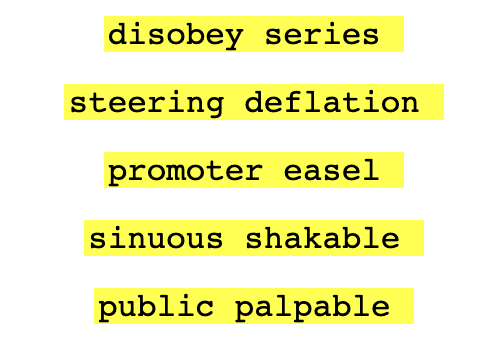
The above image is generated as follows:
A string is generated by concatenating the <roomId> with every participants’ public keys, the latter in alphanumeric order. The number of participants seen by the client is noted (‘N’)
This string is then hashed (SHA-256) and the result is folded (x-or’d) once upon itself, and the last 8 bits dropped, to generate a 120-bit ‘signature’ of the room’s ‘final state.’ This signature should be identical for all participants.
The presentation is done by translating in chunks of 12 bits to a passphrase dictionary (4096-word list). This results in 10 words in two columns of 5. The participant count is displayed prominently as well.
This signature would then obey the transitive property: all participants can pairwise confirm that they have the same signature. Words are superior to QR codes or fancy images - they can be written down, they can be read over the phone, they are (much) easier for the human mind to “match”, and they involve a minimum of additional risk (e.g. malicious QR codes etc).
An alternative approach to showing images is to pairwise challenge (automatically) through the room. Since the ‘room signature’ can be viewed as a shared secret that all participants have (and that should be identical to everybody), a simply pairwise execution of the socialist millionaires’ problem, for example the algorithm proposed by Boudt, Schoenmakerrs, and Traore (https://www.win.tue.nl/~berry/papers/dam.pdf).
Footnotes